



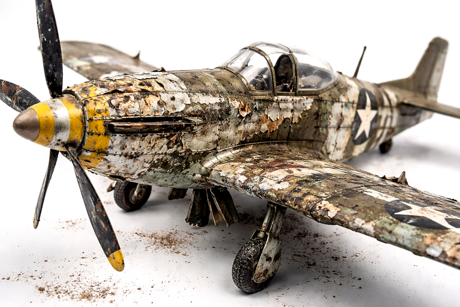
THE WORST PAINTING DISASTER
It was a 1/32 scale MiG-29 that was apparently in perfect condition. A year had passed since its completion, and I picked it up again to check that the problem had disappeared. But to my surprise, the problem was still there.
The paint became soft at the points of contact with the fingers within a few seconds but not sticky. Seemed dry.
The situation was so grotesque that on very hot days, if I pressed hard, my fingerprints would leave marks. Perhaps, if I had wanted to, I could have pushed the paint away and it would have peeled off the model as smoothly as if it were a very thin layer of latex.
The paint became soft at the points of contact with the fingers within a few seconds but not sticky. Seemed dry.
The situation was so grotesque that on very hot days, if I pressed hard, my fingerprints would leave marks. Perhaps, if I had wanted to, I could have pushed the paint away and it would have peeled off the model as smoothly as if it were a very thin layer of latex.
At that time, I bought model kits and materials at the MODELKITS LARA shop in the city of Valencia, where I lived then. And I asked its owner, Antonio Lara.
Antonio is one of those exceptional, highly respected modelers with many years of experience who always helps others. But my surprise was even greater when I saw that he was just as surprised as I was.
Antonio asked the usual questions: types of paint, layers, and drying time. A white acrylic primer was used to take advantage of its color intensity and completely smooth finish. It was left to dry for months, due to my limited time as a computer analyst and as a precaution. Only then was painted with enamel. This seemed perfectly normal, as the drying time had been well respected.
Antonio is one of those exceptional, highly respected modelers with many years of experience who always helps others. But my surprise was even greater when I saw that he was just as surprised as I was.
Antonio asked the usual questions: types of paint, layers, and drying time. A white acrylic primer was used to take advantage of its color intensity and completely smooth finish. It was left to dry for months, due to my limited time as a computer analyst and as a precaution. Only then was painted with enamel. This seemed perfectly normal, as the drying time had been well respected.
A couple of months later, when I thought he had forgotten about it, he told me, "I have the answer to your problem."
The first layer of acrylic had dried perfectly for months. Yes.
But the problem occurred when applying the second coat of enamel, which was quite diluted with solvent to cover with a very thin and light layer.
The solvent attacked the underlying acrylic layer, which is not designed to withstand this type of acidity. And the paint, despite having been dry, dissolved beneath the enamel layer.
The first layer of acrylic had dried perfectly for months. Yes.
But the problem occurred when applying the second coat of enamel, which was quite diluted with solvent to cover with a very thin and light layer.
The solvent attacked the underlying acrylic layer, which is not designed to withstand this type of acidity. And the paint, despite having been dry, dissolved beneath the enamel layer.
One cannot perceive what is happening beneath the top layer. One only sees that the top layer of enamel appears to be dry, and then proceeds to apply the second light coat.
The effect, though it may seem incredible, is that a completely dry plastic film has formed on top of an underlying layer of acrylic that is being attacked by the solvent.
This upper plastic film, which is more resistant to the solvent's acid, prevents the solvent from evaporating from the lower layer. This leaves a paste that never dries, and whose reaction intensifies with the warmth of the touch.
The effect, though it may seem incredible, is that a completely dry plastic film has formed on top of an underlying layer of acrylic that is being attacked by the solvent.
This upper plastic film, which is more resistant to the solvent's acid, prevents the solvent from evaporating from the lower layer. This leaves a paste that never dries, and whose reaction intensifies with the warmth of the touch.
Both Antonio and I were very aware of the risks of mixing acrylics with enamels. But neither of us had any idea that the chemical reaction could reach this point.
In any case, the paint using a more acidic solvent (enamel) should be the bottom layer and the acrylic the top layer. Otherwise, it should be such a thin layer that it allows the acrylic paint underneath to breathe.
In any case, the paint using a more acidic solvent (enamel) should be the bottom layer and the acrylic the top layer. Otherwise, it should be such a thin layer that it allows the acrylic paint underneath to breathe.
