




NO, WE ARE NOT THE SAME
Tecnikit is an attempt to create the best-detailed models in the world, as this level of detail didn't exist in the market. Previous experiences had already demonstrated that 3D design was far superior to using scratch-building or molds. Then, it took over 10 years to learn 3D design, and finally, was acquired what experts considered to be the best 3D printer in the world. Lastly the company was launched to recoup some of the effort.
Afterwards came the reviews. Mostly positive. But some were too destructive and illogical to be disinterested. That's why this article is being written. To express our point of view.
The "they're all the same" strategy involves making a value judgment about an entire sector or technology, generally assigning it a medium or low quality standard. The aim is to overlook and dismiss, as if pruning a hedge, all those that stand out in quality above the rest and even above themselves.
The only certainty is that some designers are selling unique 3D designs to the public for over €1,000, while others are forced to undervalue them or practically give them away. Similarly, some printer manufacturers routinely sell 3D printers for €5,000, while others sell similar models for €300.
The only certainty is that some designers are selling unique 3D designs to the public for over €1,000, while others are forced to undervalue them or practically give them away. Similarly, some printer manufacturers routinely sell 3D printers for €5,000, while others sell similar models for €300.
However, some manufacturers and some of their followers insist that basically all designs are the same and all resin-based 3D technologies are the same.
We are experiencing the beginnings of 3D printing, just as happened with 2D laser and inkjet printers for paper 30 years ago.
Just as then, there are parallel technologies that are competing and improving. But as happened with ink, certain technologies are, by definition, better.
We are experiencing the beginnings of 3D printing, just as happened with 2D laser and inkjet printers for paper 30 years ago.
Just as then, there are parallel technologies that are competing and improving. But as happened with ink, certain technologies are, by definition, better.
However, when you're young, your first car is the best. And social media and forums allow these opinions, even from inexperienced users who have never worked with other systems, to be interpreted as verified information by people seeking objective data.
Some manufacturers of lower-quality 3D printers minimize or hide certain parameters that are crucial for determining quality. This, of course, is not accidental. And their followers, readers of their marketing materials, similarly omit this vital information in supposed competitive tests of models and brands, which ultimately are nothing more than poorly researched and flawed analyses.
Some manufacturers of lower-quality 3D printers minimize or hide certain parameters that are crucial for determining quality. This, of course, is not accidental. And their followers, readers of their marketing materials, similarly omit this vital information in supposed competitive tests of models and brands, which ultimately are nothing more than poorly researched and flawed analyses.

As summarized by Google's AI, SLA (laser) printers hold absolute supremacy in the world of 3D quality and precision. Anyone familiar with 3D printers knows that they win the most rigorous accuracy tests.
We won't even offer our own perspective. Below is the summary that Google's AI, based on all its content, provides regarding this matter.
We will only point out that, to avoid lengthening its explanation, Google mentions MSLA as a comparable technology, which, among all the other rivals to SLA, is the most precise.
We won't even offer our own perspective. Below is the summary that Google's AI, based on all its content, provides regarding this matter.
We will only point out that, to avoid lengthening its explanation, Google mentions MSLA as a comparable technology, which, among all the other rivals to SLA, is the most precise.
SLA (Laser) Precision/Detail Maximum (fine)
MSLA / DLP Precision/Detail High (pixelated)
SLA (Laser) Edges Soft
MSLA / DLP Curved Pixelated, stepped
And it concludes by saying: “While SLA offers greater precision, MSLA has become the consumer standard due to its speed and low cost, despite the limitations mentioned.”
We hope we have made the difference between information and opinion clear. And of course, we are not the same as those who use lower-cost technologies.
MSLA / DLP Precision/Detail High (pixelated)
SLA (Laser) Edges Soft
MSLA / DLP Curved Pixelated, stepped
And it concludes by saying: “While SLA offers greater precision, MSLA has become the consumer standard due to its speed and low cost, despite the limitations mentioned.”
We hope we have made the difference between information and opinion clear. And of course, we are not the same as those who use lower-cost technologies.
Being at the pinnacle of quality also implies a much higher cost. We were the first to do so in this specialty, and to date, we are unaware of any other manufacturers doing so due to the low profitability.
Some modelers believe that achieving this level of quality is unnecessary. In our opinion, it depends on why you are acquiring a detail kit to improve your model.
There is a significant difference between acquiring a detail kit to correct a defect in the original model and acquiring it to transform the model into a faithful scale reproduction.
Some modelers believe that achieving this level of quality is unnecessary. In our opinion, it depends on why you are acquiring a detail kit to improve your model.
There is a significant difference between acquiring a detail kit to correct a defect in the original model and acquiring it to transform the model into a faithful scale reproduction.
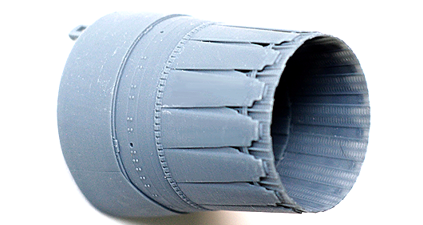
It seems necessary to remember that detailed models are not required to enjoy model making and that they are not an essential part of this hobby.
But if you go in, for us, 3D-printed parts that need extensive sanding to remove defects caused by jumps and printing aberrations obvious should be unforgivable are unacceptable. In our opinion, they don't deserve any price, no matter how low.
Ultimately, the problem is achieving and maintaining a superior level of quality. Otherwise... why sell 3D-printed resin parts ?
But if you go in, for us, 3D-printed parts that need extensive sanding to remove defects caused by jumps and printing aberrations obvious should be unforgivable are unacceptable. In our opinion, they don't deserve any price, no matter how low.
Ultimately, the problem is achieving and maintaining a superior level of quality. Otherwise... why sell 3D-printed resin parts ?
At this point, the remaining critics "teach" us that our mistake is not printing the parts at low-cost Asian companies. And once again, they speculate in unfamiliar territory.
Some of these companies can print at the level of quality we're looking for. But then they break the budgets they usually offer in their attractive bids.
Furthermore, the same level of attention to detail cannot be expected from mass printers who might print your model or a bottle. If the price difference is reduced and you don't have complete control over quality control, the choice should be clear for anyone if you want a top-quality result.
Some of these companies can print at the level of quality we're looking for. But then they break the budgets they usually offer in their attractive bids.
Furthermore, the same level of attention to detail cannot be expected from mass printers who might print your model or a bottle. If the price difference is reduced and you don't have complete control over quality control, the choice should be clear for anyone if you want a top-quality result.
Before purchasing a product, you must review the photographs of the real piece. Not only the 3D renderings. It's true that we can't yet show photographs of all products, ( our real failure ) but there are more than enough photographs to see the final result of surfaces and details we offer.
Good-faith criticism is always welcome. But criticism done to feel superior not. Talking is easy and free. Working well and hard not.
Some modelers buy details based on price. Others prioritize accuracy. These are completely different markets. Everything else is just noise stemming from ignorance or self-interest.
Good-faith criticism is always welcome. But criticism done to feel superior not. Talking is easy and free. Working well and hard not.
Some modelers buy details based on price. Others prioritize accuracy. These are completely different markets. Everything else is just noise stemming from ignorance or self-interest.
