




F-16 PANELS DOWN
If the goal is to make a realistic model, the nozzle must be treated as just another mechanical element, because that is what it is. And when the engine stops, the panels fall under their own weight. Because they are moving parts with a certain amount of slack.
This image shows one of the three variants with the engine shut down from the nine nozzles we have available for the PW-229 engine for the F-16.
36 versions in total if we also take into account those that include the entire afterburner up to the fuel injectors. And the adaptations that our friend Nemeth from Budapest in Hungary commissioned for Tamiya's F-15E, Tamiya's F-16CJ BLOCK 50, and Academy's F-16I SUFA BLOCK 52. This required different afterburner covers and outlets to be made
36 versions in total if we also take into account those that include the entire afterburner up to the fuel injectors. And the adaptations that our friend Nemeth from Budapest in Hungary commissioned for Tamiya's F-15E, Tamiya's F-16CJ BLOCK 50, and Academy's F-16I SUFA BLOCK 52. This required different afterburner covers and outlets to be made
The PW-229 engine converts Tamiya's F-16 BLOCK 50 model into a BLOCK 52. This is not the case with Academy's Israeli F-16I SUFA model, which, like most current export models of the F-16, is already a BLOCK 52 as it incorporates this engine and other avionics.
As with all jet engines that I can remember, some more than others depending on the mechanisms and wear and tear of the engines, the external panels, petals or turkey feathers as they are also known, have a slight angle of descent due to their own weight.
As with all jet engines that I can remember, some more than others depending on the mechanisms and wear and tear of the engines, the external panels, petals or turkey feathers as they are also known, have a slight angle of descent due to their own weight.
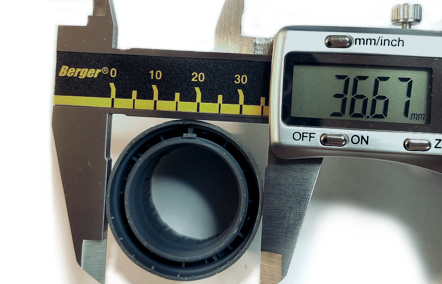
A small sample sent by Nemeth from Budapest from his extensive and demanding work of verification and adjustment.
The ring formed by these rotating panels regulates the diameter of the discharge jet. This is achieved by fixing the panels to hinges that allow them to rotate and pushing them toward the center of the ring by means of bars. Wear and tear on the hinges due to stress and temperature changes causes a slight tilt toward the floor at the ends of these panels when there is no power.
However, this inclination is much greater in the upper and lower panels because the drop coincides with the usual angle of rotation of these parts. That is why our detailing also has a progressive drop.
However, this inclination is much greater in the upper and lower panels because the drop coincides with the usual angle of rotation of these parts. That is why our detailing also has a progressive drop.
When the engine accelerates and the jet of thrust is released, an effect similar to that of a crumpled hose through which water suddenly flows under pressure is produced.
It tightens and stiffens, forming a perfect circle. This happens because the pressure pushes the walls outward.
Similarly, the panels are crimped together. This distributes the pressure among them, pushing them outward to form a perfect circle that cannot open beyond the opening dictated by the controls for each power level.
It tightens and stiffens, forming a perfect circle. This happens because the pressure pushes the walls outward.
Similarly, the panels are crimped together. This distributes the pressure among them, pushing them outward to form a perfect circle that cannot open beyond the opening dictated by the controls for each power level.
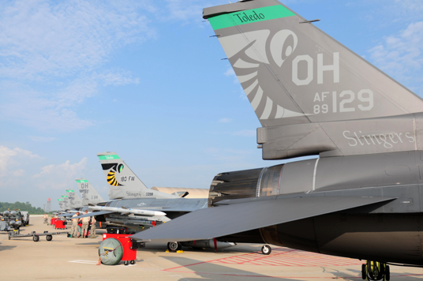
Photo courtesy of Airman Hope Geiger and the 180th Fighter Wing showing the nozzle of an F-16 BLOCK 52
Is this so important that it is necessary to use specific versions with this effect?
The answer is very clear. Of course, if you are looking for a good level of realism.
Nemeth collaborated in an exceptional and demanding manner for months to obtain perfect nozzles. He sent us exceptional photographs of both real F-15s and F-16s, and we sent him prototypes that he checked on his three models, sending us photographs of measurements and adjustments.
In the final stage of the design, we clashed because we couldn't agree on the line of the petals in relation to the fuselage.
The answer is very clear. Of course, if you are looking for a good level of realism.
Nemeth collaborated in an exceptional and demanding manner for months to obtain perfect nozzles. He sent us exceptional photographs of both real F-15s and F-16s, and we sent him prototypes that he checked on his three models, sending us photographs of measurements and adjustments.
In the final stage of the design, we clashed because we couldn't agree on the line of the petals in relation to the fuselage.
Reviewing carefully the criticism, we observed that the problem was not the accuracy of the model. The problem was that we had not planned to make a version with the engine stopped. But the client was right. It wasn't good.
If you are as demanding a modeler as Nemeth, you will not accept that the silhouette of the F-16 does not match that in the photographs.
We have occasionally read scathing criticisms about other modelkits manufacturers from certain critics who readily compare models to blueprints, but they have never pointed out this detail. This is likely because they are unaware of it, as it is not shown on the blueprints.
If you are as demanding a modeler as Nemeth, you will not accept that the silhouette of the F-16 does not match that in the photographs.
We have occasionally read scathing criticisms about other modelkits manufacturers from certain critics who readily compare models to blueprints, but they have never pointed out this detail. This is likely because they are unaware of it, as it is not shown on the blueprints.
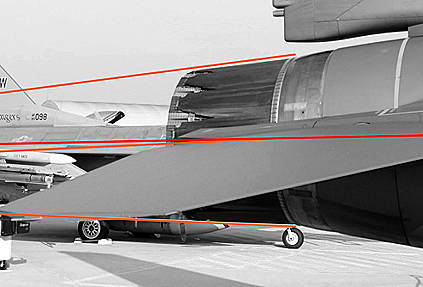
We took the photo courtesy of the 180 fighter wing and enlarged the tail section of the F-16 BLOCK 52. There is a perspective effect that is not ideal for showing this effect. However, we do not have the license to publish photos where the angle is much clearer.
The fuselage axis is the red center line. As is often the case with modern fighter jets, the nozzle is subtly raised, pointing upwards to cause a slight pitch of the aircraft's nose.
But as can be seen, the nozzle petals fall in the opposite direction towards the ground, as indicated by the orange lines.
The fuselage axis is the red center line. As is often the case with modern fighter jets, the nozzle is subtly raised, pointing upwards to cause a slight pitch of the aircraft's nose.
But as can be seen, the nozzle petals fall in the opposite direction towards the ground, as indicated by the orange lines.
The silhouette of the F-16 changed completely with the slightest angle of descent. It is these small details that seem imperceptible that add that touch of realism.
It's something that, if it's missing, makes the object well made but not realistic. Even if at the time you don't really know what's wrong with it.
It clearly defines the extent to which each detailing manufacturer is willing to go. In our case, the versions with the engine off helped us detect some rotational defects in the internal mechanisms of the other versions with the engine running.
It's something that, if it's missing, makes the object well made but not realistic. Even if at the time you don't really know what's wrong with it.
It clearly defines the extent to which each detailing manufacturer is willing to go. In our case, the versions with the engine off helped us detect some rotational defects in the internal mechanisms of the other versions with the engine running.
