



They began as pieces for a personal project in 1/32 scale, and have been our greatest success until the appearance of the J-58. And now, by customer request, much of them will be also available in 1/48 scale.
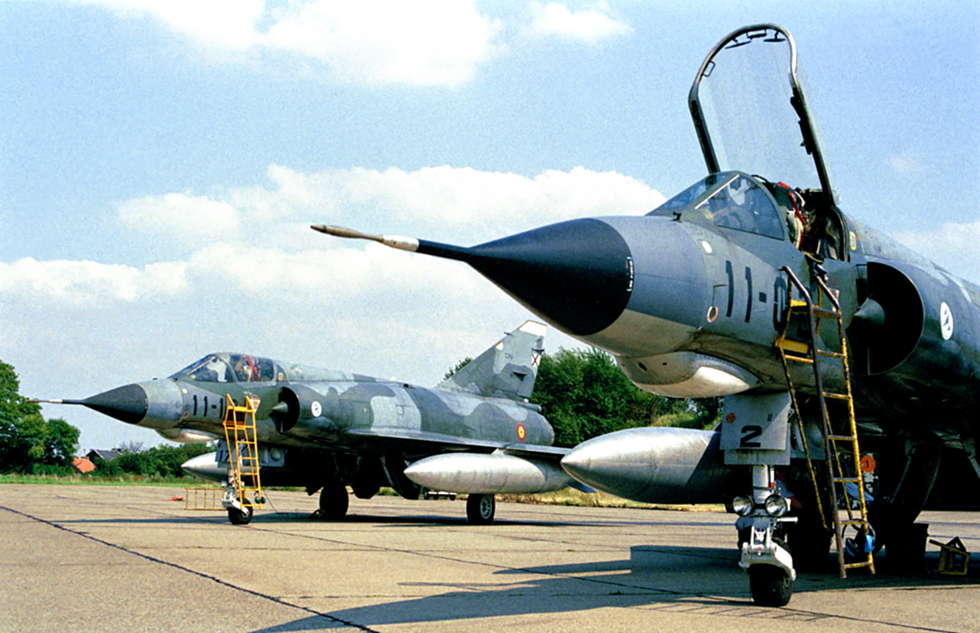
We reproduce this fantastic photograph protected by explicit reproduction rights with the permission of its author, Jean-Marie Hanon, showing two Mirage IIIE aircraft in their Spanish version (EE) belonging to ALA 11 of the Spanish Air Force, which at that time had its base of operations at Manises airport near the city of Valencia. The photograph shows them resting during a visit to Kleine Brogel Air Base in Belgium.
DETAILSETS MONOGRAPH FOR MIRAGE IIIE
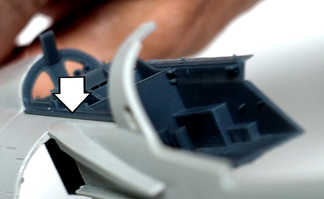
The avionics compartment detailset consists of the inverted flight fuel tank, oxygen cylinders for the pilot, the well with some elements at the bottom, and the partition separating the electronic elements from the cylinders, the rotating aluminum rack, the computer, and the radio equipment.
The pieces are separated to allow for easy painting and to prevent resin and paint from accumulating in the joints.
This super-detailset is for experienced modelers.
This is because joining the pit to the fuselage requires careful cutting of the fuselage and adjustment of the detailing. It also requires bending and adjusting some very fine brass cables and wires.
In addition, many elements are metallic colors, ranging from chrome to aluminum. Therefore, it is important to know how to select and use the appropriate metallic paints to avoid the false effect of “silver plastic.”
For the 1/48 scale version, it has been necessary to modify several parts.
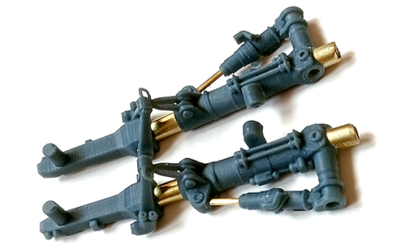
The rear landing gear, combining high-quality 3D resin detail with the strength of metal, was another of our achievements in 2022, as a part already on sale at the start of the company in 2023. The history of our experiences with brass and its integration is explained in detail in our first article called SCRATCH WITH BRASS.
Every experienced model maker is familiar with the problem of removing the mold lines left by injection-molded plastic on each side of the axle cylinders and landing gear shock absorber sleeves.
Removing them can flatten the cut area, leaving a flattened cylinder, and also coincides with the diameter variations in the different sections. This complicates already delicate cuts, which are then highlighted by metallic paint and washes
The structure of this part of the train is more complex than shown in the photograph. But it is more interesting to look at the hydraulic fittings, where the model maker must insert brass wire to reproduce the hydraulic circuit on their own. As well as the ring on the flexion elbow, which serves to keep the cables in place as they pass alongside the main shock absorber shaft.
As we explained in the article, over time plastic dries out and becomes very brittle. Having brass columns instead of thin plastic tubes in models of a certain size is reassuring.
Since inserting and drilling the columns posed a risk of breakage, we sell this detail with the metal columns already inserted and glued inside the 3D covers.
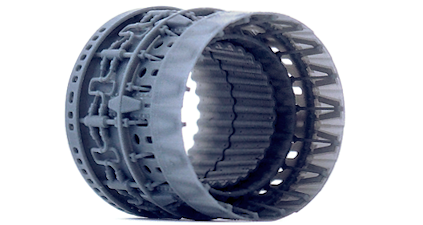
The inner nozzles have also been one of our contributions to the world of model making. Sometimes, simply doing research leads to information that reveals details we find interesting enough to devote a special piece to.
In the case of the 09C5 engine that equips the IIIE model, we have released multiple versions. All of them offer the option of including the nozzle with the cover as it would normally be fitted on the aircraft, or as shown in the photograph, with the cover removed. This allows you to see the hydraulic thrust pistons for the petal closure mechanism at the outlet of the afterburner chamber
These two variants apply to the complete 09C5 engine versions, from the afterburner chamber to the nozzle, or just the nozzle.
In all cases, the utmost care has been taken to ensure that the thicknesses of the visible structures are accurate to scale. This is why the nozzle petals appear semi-transparent, due to the thinness of the layer.
This is one of the main characteristics of the most advanced model making. It is not permissible to show thicknesses that are completely out of scale, due to the limitations of the injected plastic when it is removed from the molds.
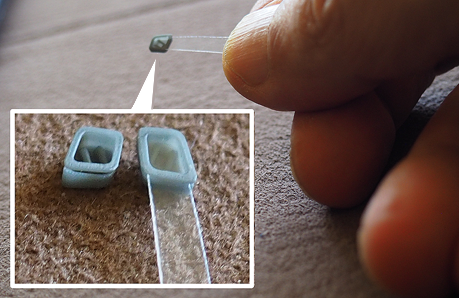
The set of parts for detailing the exterior has been another success. It includes several grilles, the interior of the air brake well, side openings for air intake to the engine, a power outlet under the fuselage, and emergency handles for opening the cockpit.
The exterior details are, as a whole, a high-quality finishing touch to the model in various areas.
Not only do they eliminate the most obvious flaws in the original model, but they also delve deeper into these points, providing an exceptional level of detail that transforms the weakest elements of the original model into the most realistic and believable ones.
For example, the handles are very curious due to their small size.
However, they include another contribution from Tecnikit, with rails and an opening that allow a thin sheet of transparent plastic to be slid under the frame of the handle box, imitating breakable glass.
It may seem like a naive detail. But the presence of transparent panels showing the handles is much more effective than decals or, worse still, a plate with rivets in their place.
This is another small contribution from us that will be widely used in upcoming monographs.

To conclude, at least for now, the MATRA R530 missile, which represents an entire era in the history of these fighter jets.
You can choose between an infrared or radar seeker head, with two mounting options available.
One with the missile already mounted on its launcher, and another with the launcher still bolted to the fuselage and without the fairing, allowing you to see the launcher's anchors to the fuselage, next to the missile on its transport trolley on the runway.
The missile also includes decals with the letters and numbers needed to apply the national nomenclature that the modeler wishes to apply to his model.
Includes decals with warning and cautionary legends in English and French. This allows the modeler to better adapt the missile to their model.
As you can see, the collection of details for this fighter model is exceptional. More than 42 pieces that can be assembled in different combinations depending on what the modeler prefers.
Even more so considering the adjustments had to be made in order to launch much of them in 1/48 scale.
In the case of the rear landing gear, the decision was made months ago not to produce it at 1/48, even though there was a customer order for it. The resin cover well scaled, was not strong enough due to its thinness in a structural part that must support weight.
We do not rule out any surprises in the future for this beautiful French fighter jet.
