



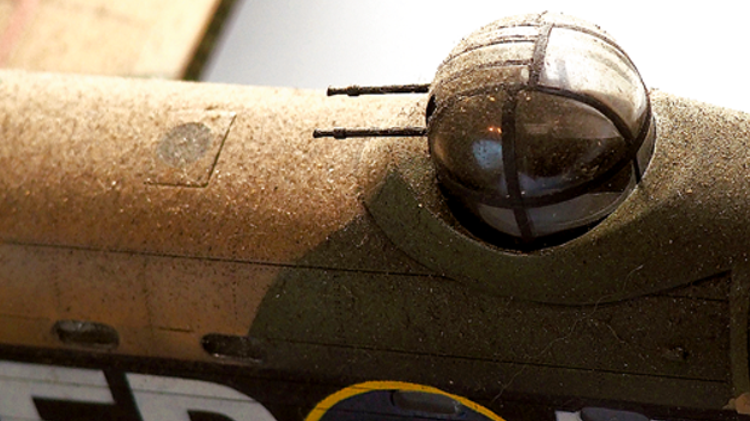
THE DUST IS OUR ENEMY
Obviously we live in a different world and modelkits building cannot escape this change. But it gives the impression that many young modelers are looking for easy and fast results to expose their works on social networks without worrying at all about the durability of their models over time.
In this article another point is addressed to obtain durable models. How to make modelkits to prevent and avoid the accumulation of dust and dirt that will be impossible to remove in the future.
Large models like this Lancaster at 1/48, are often a dust heap due to the lack of space to expose them. This one, for example, was on top of a stint of 2 years... but we are not worried about it. It was prepared from its assembly to be watertight and its paint supports the cleaners.
The dust enters inside the models through the small openings. And often the fine dust is accompanied by vapors coming from cooking smoke, tobacco or powder, which eventually leaves behind a thin layer of dirt adhered as if it were an opaque varnish that worsens over time.
The dust enters inside the models through the small openings. And often the fine dust is accompanied by vapors coming from cooking smoke, tobacco or powder, which eventually leaves behind a thin layer of dirt adhered as if it were an opaque varnish that worsens over time.
You can clean it on the outside but not inside.
It is very sad that after working long hours to make these pieces perfectly transparent, it starts at the few years an inexorable process of veil that you cannot avoid in the inner part of these transparent pieces and that ends up impeding the observation of the internal details.
It is a fact that when this dirt gets stuck to plastic, the surface of these transparent pieces no longer feels smooth, slippery and thus repellent from successive layers of dirt, which accelerates the deterioration.
In the special case of this Lancaster was evident that with so many transparent cupolas the effect of internal dirt would be disastrous. And that’s why when we designed the Tecnikit machine gun assemblies, it was thought out, designed, and tested - a way to prevent this dirt from entering as much as possible.
To achieve this, the mounts incorporate almost imperceptible details that close and seal the holes in the transparent domes by which the machine guns pass through, making these cupolas hermetic. And in the case of the tail tower, extra openings on the pad that should not be there and are also now closed.
To achieve this, the mounts incorporate almost imperceptible details that close and seal the holes in the transparent domes by which the machine guns pass through, making these cupolas hermetic. And in the case of the tail tower, extra openings on the pad that should not be there and are also now closed.
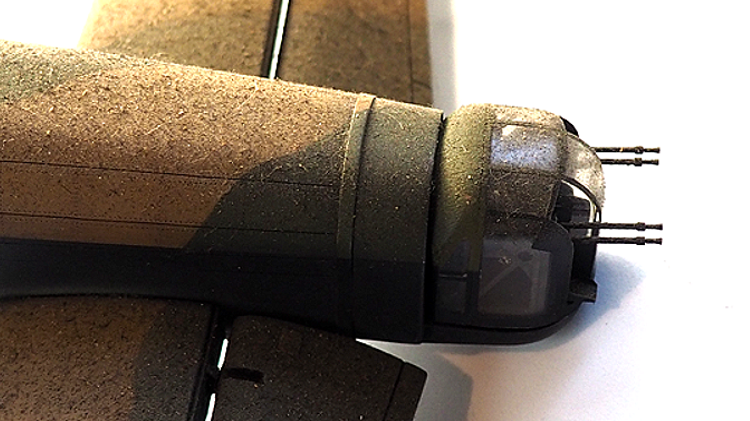
This prevents dust from entering the interior, maintaining a cleanliness of the transparent surfaces that any experienced modeler could come to believe was possible.
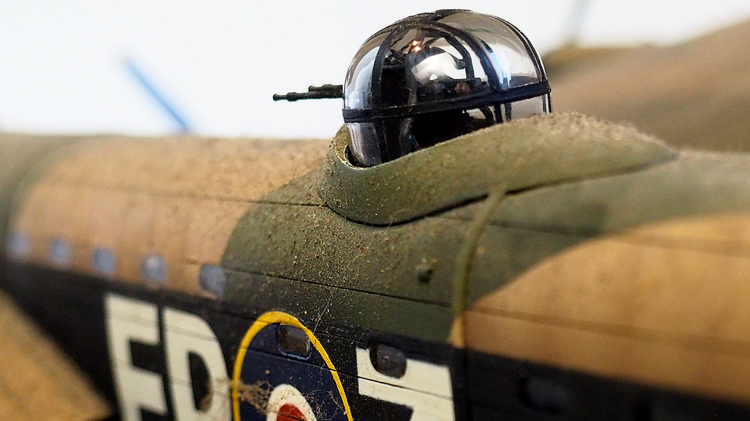
The superior photographs show the lamentable state of dust accumulation that, as can be seen, was meant to frighten anyone. However as can be seen in the lower photo, after cleaning the outside of the cupola, the clarity and transparency are perfectly observed without any trace of dust or glazes inside.
An entire success of its functionality.
Can anything be done without such measures ?
The only possible is to insert through some opening a soft brush with flexible handle or use the pressure of an airbrush to blow air indoors through an opening. But it is impossible to access all the precise angles for thorough cleaning.
An effective system is to use a tube as a cable sheath or a drink straw, which by its fineness and flexibility can enter through small holes and can be bent to bring its end closer near the cupola. By connecting the opposite end of the airbrush mouth, it is possible to direct and maintain the air pressure up to it.
This solution is effective the first few years to postpone the stickiness of dirt with cleaning from time to time if there is no other remedy. But the inability to make contact with cleaners does inevitable the problem in the medium term.
From here the importance we give to the sealing of air inlets. We avoid concerns and very difficult maintenance jobs with a bitter ending in not many areas.
And now we’re going to address the other side of the coin. The exterior cleanliness. ¿ Have you provided that the paints and varnishes you use can be cleaned with cleaning products ?. I’m afraid with the current fads that overflow social media, the answer is... "No has been thought about it."
It is inevitable that over time, the exterior must be cleaned. With or without showcase. And it depends on the types of paints used, whether or not to use cleaners that restore the brilliance of models.
Decades ago there were two opposing options. Synthetic enamel or acrylic. And everyone knows perfectly that to ensure effective cleaning without fear of disasters the response is enamelling. Its hardness has been tested throughout decades with all kinds of cleaners. Especially the brilliant ones with the highest synthetic resin composition.
But not to think about this question and other advantages of the acrylics such as their thin layers and ranges of vibrant shades, convinced many modelers of their use without thinking about the cleaning.
Many think they can save this inconvenience by using a enameled varnish finish. But the use of synthetic varnishes on acrylics has unforeseeable effects due to adverse chemical reactions, such as by the long-term yellowing effect, once the UV filter that these resins incorporate into their application expires, however much the advertising campaign denies it.
To this must be added the experience that I describe in another article called "THE WORST PAINTING DISASTER". Which describes how easy it is to have long-term adverse effects when mixing chemicals from different families.
Only the application of a very thin layer could avoid these situations. But precisely this fineness layer is the problem being dragged by a cloth dampened with cleaner.
In the end, it is very difficult to advise on this matter because, moreover, certain manufacturers have launched products that they call acrylics, but which are nevertheless dissolved with enamel solvents and not with water or alcohol as previously was the norm for a product called acrylic.
This shows that certain companies are playing with mixed compositions that make it impossible to predict the behavior of these paintings in the long run with cleaners.
Finally, trying to convince many modelers to return to enamel to ensure the durability of their finishes after cleaning them again and again is not going to be accepted by a current fashion based on the use of acrylic. Although someone may wonder what a cleaner can be used that does not dissolve an acrylic after few years, if not, at the first pass.
