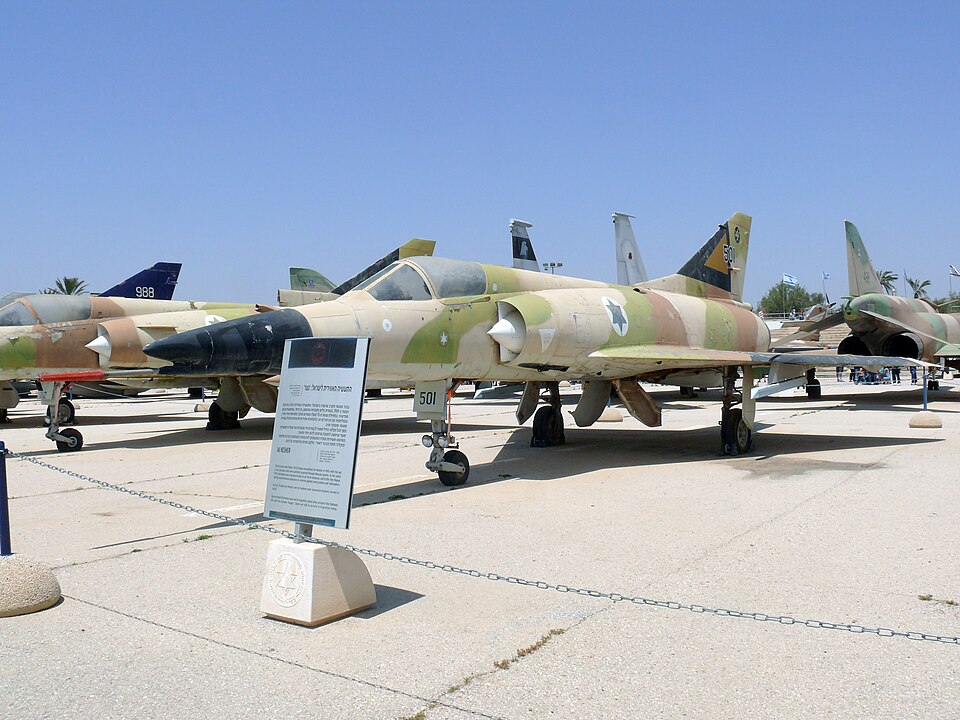
Photograph by Math Knight of a Nesher A at the Beersheba Air Base Hatzerim Museum. Source:
Wikimedia CommonsThe story states that an engineer named Alfred Frauenknecht was tried for espionage on behalf of Israel for stealing documents while working on the Mirage IIIS (the Swiss variant).
From there, this account explains that, thanks to his experience and the stolen blueprints, he led a project to clone the Mirage 5 in Israel.
Another version claims he only worked on the engine, that his documents were therefore limited to this area, and that other blueprints for the Dassault Mirage 5 were somehow obtained to complete the rest of the aircraft.
The fanciful version speculates on a possible connection between Israel and the South African Mirage variant known as the Cheetah.
But the most entertaining version involves the use of reverse engineering to replicate the Mirage IIIC, and then, on his own initiative, changing the engine, which necessitated widening the fuselage and modifying the wings and landing gear.
We want to believe that everything published is the work of people with no engineering knowledge, who copy and paste it into forums and publicly accessible knowledge databases.
But alarm bells ring when this content is published in specialized forums or in a technical book about these aircraft with a certain level of quality and depth. This seems to lend an air of authority to these accounts. Even in the article "IAF Aircraft Inventory: Israel Aircraft Industries Nesher" from the Jewish Virtual Library.
It shouldn't be necessary to explain that building such an aircraft requires exceptional experience in design and manufacturing.
If the espionage had been carried out by the United States or the Soviet Union, it would have been credible due to their extensive and deep knowledge of the "know-how"—an expression that seems to have disappeared.
France has a renowned history of aeronautical engineering dating back to the very beginning of aviation. But for some reason, it's not well known, which, to be charitable, might have led some to believe that imitating them wouldn't be too difficult.
But facilities such as wind tunnels, armored engine testing chambers, tooling, materials manufacturers, assembly lines—in short, expert infrastructure—are also necessary.
A country embarking on this journey would need a very long learning process. But the dates indicate that it was built in just two years. A record only comparable to the time it would take an established company to launch a simple new variant of an already standardized model.
To top off this absurdity, these aircraft claimed 25 kills in the Yom Kippur War. Among them were Soviet aircraft built by engineers from some of the world's best manufacturers: MiG and Sukhoi.
Perfected over decades in all kinds of missions and climates, with a long history of learning in real combat during the Korean and Vietnam Wars.
However, the idea that a country that had never flown anything before managed to put its own squadron of fighter-bombers into service in just two years with only a set of blueprints is repeatedly emphasized.
Fortunately, there seems to be evidence that refutes all of this and offers a completely opposite version.
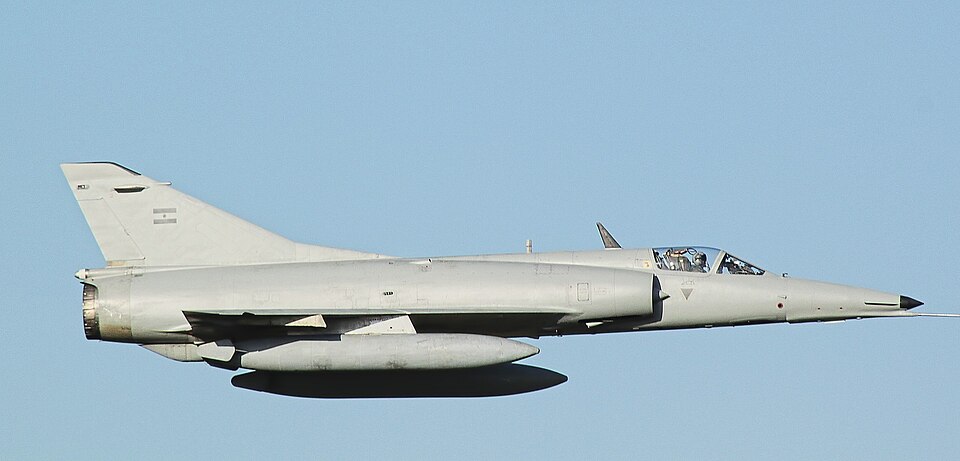
Photograph by Jorge Alberto Leonardi of a Nesher resold to the Argentine Air Force as an IAI Finger. Source:
Wikimedia CommonsIn June 1967, President de Gaulle imposed an arms embargo due to the escalating tensions between Israel and the Arab world, at a time when Israel already had an order for around 50 Mirage 5Js. The "J" indicates that it is a version developed to Israel's specifications.
It is at this point, according to these accounts, that Israel was forced to undertake its own development to clone the Mirage 5.
Meanwhile, France was negotiating agreements that materialized in just a few years. With Mirage sales to Libya, Lebanon, Abu Dhabi, the United Arab Emirates, and Egypt, the largest contract being with Libya, for which 110 aircraft were delivered. Iraq and Egypt would later join the list.
With this sales volume, it's reasonable to speculate that sending 50 Mirage 5Js to Israel would have been an unforgivable offense to the Arab world at that time. Ironically, this was resolved when Israel, according to the story, built Mirage aircraft without Dassault and without French involvement.
The most realistic explanation can be found in Tom Cooper's article, "The True Story Behind Israeli Nesher Fighter, the Mirage 5 Built by Rockwell (and Not by IAI)," published in November 2019 on theaviationgeekclub.com.
It describes how, in January 1968, Rockwell International reached an agreement with Dassault to send Mirage 5Js to Israel. And to better conceal the violation of the embargo, the fuselages were manufactured by Aerospatiale, the wings by Reims-Cessna, while the engines were manufactured by SABCA, Dassault's Belgian subsidiary.
The article goes on to explain how the 51 Mirage 5Js and 10 Mirage 5DDs were shipped to Israel aboard USAF C-141 Starlifter transport aircraft in 1970.
They were then assembled by a team of Rockwell engineers at what was then known as Israel Aircraft Industries (IAI).
But there's more. On zona-militar.com, an interview with one of the key figures in the project was featured in the American magazine Wings in 2001: none other than the American aircraft designer Gene Salvay.
Salvay explained that he had worked for North American since World War II, participating in the design of models such as the B-25, F-86, and F-100.
In the mid-1960s, North American was acquired by Rockwell. Originally specializing in the manufacture of automotive parts.
By 1970, Salvay was one of the leading aircraft designers in the United States. And Rockwell sent him to Israel to help install the General Electric J-79 engine in the Mirage fuselage.
He thus witnessed the delivery and assembly of the Mirage 5Js by American technicians at IAI.
But another myth is debunked in this story. Salvay later designed the Kfir with considerable assistance from Lockheed and Dassault, before returning to the US, where he designed the B-1 bomber, among others.
We are therefore dealing with one of those exceptional masters with outstanding experience and knowledge, the kind I mentioned earlier as essential for this type of project. This lends meaning and strength to this version.
In conclusion, the difference in seriousness and rigor is immediately apparent when comparing the two accounts. Choosing Gene Salvay, one of the world's best designers, for a project that initially only involved applying changes to pre-existing aircraft.
As well as the need for assistance to make more significant changes from Lockheed and Dassault for the Kfir.
Some details, other specifics, and sources have been omitted to avoid making this article too long.
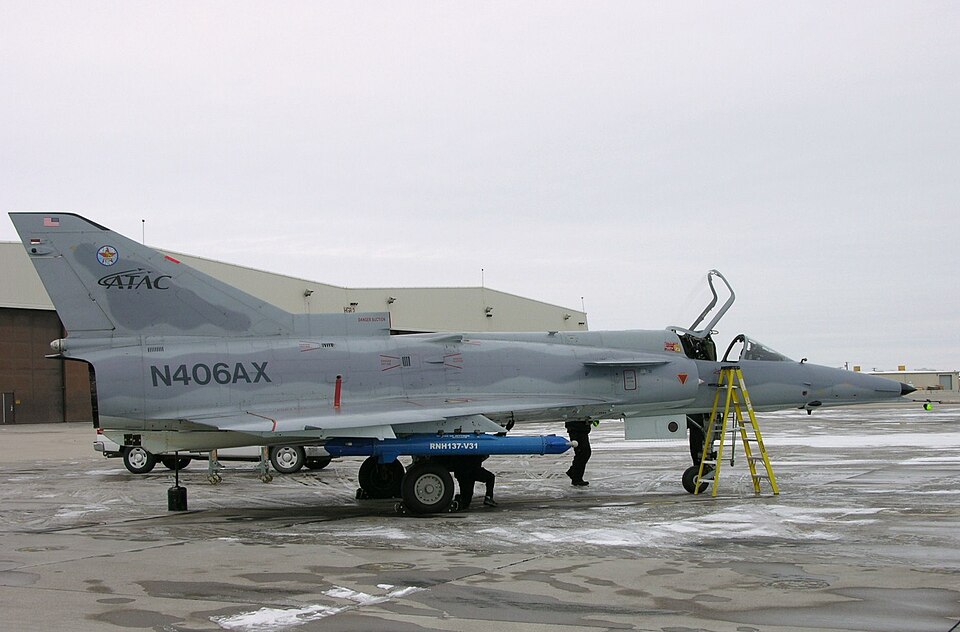
Photograph by Jerry Gunner of a Kfir acquired by ATAC (Airborne Tactical Advantage Company) Source:
Wikimedia Commons 





